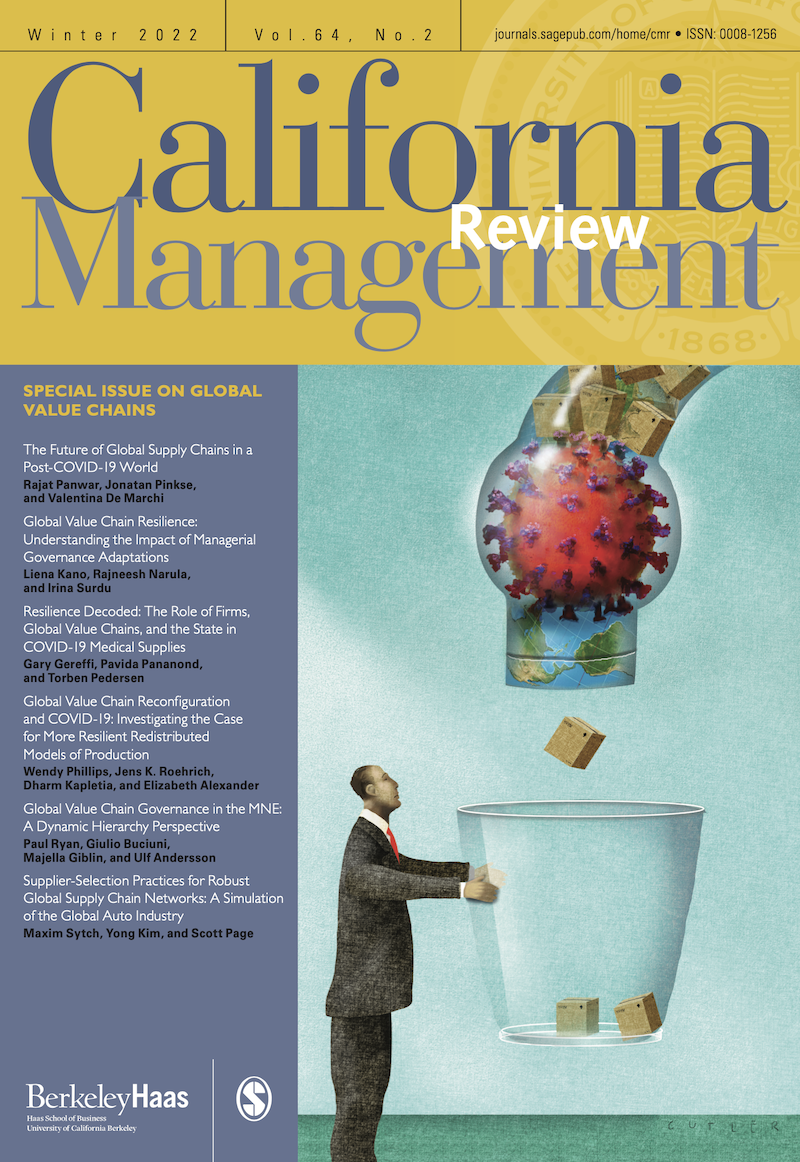
California Management Review
California Management Review is a premier academic management journal published at UC Berkeley

by Maxim Sytch, Yong Kim, and Scott Page

Image Credit | Maksym Kaharlytskyi
How can companies develop and maintain global supply chain networks that are robust—that is, capable of maintaining an uninterrupted flow of goods and materials— when confronted with a geographically spreading disruption that could cause the shutdown of multiple suppliers at once? To answer this question, this article combines an empirical analysis of supply chain networks of three global automotive manufacturers with computational experiments. The results reveal that even when a small fraction of buyers adopt regionalizing supplier-selection practices—those in which a buyer chooses geographically proximate suppliers, whether to the buyer or its current suppliers—the supply chain network becomes more robust.