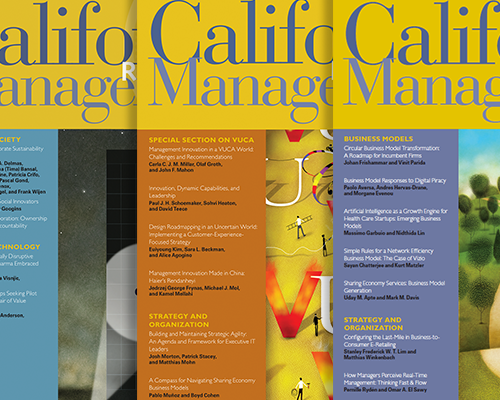
California Management Review
California Management Review is a premier professional management journal for practitioners published at UC Berkeley Haas School of Business.


Our fall issue features contributions on digital transformation, social innovation, board governance, and partnerships
A new kind of practitioner-focused research designed to complement our traditional In-Depth articles

Treat compliance as a strategic capability rather than a back-office burden
 Insight
Egi Nazeraj
Insight
Egi Nazeraj

Ørsted has implemented many project-by-project community benefit initiatives
 Case Study
Dara O'Rourke and Robert Strand
Case Study
Dara O'Rourke and Robert Strand

Image Credit | Tulip Design
In 2005, Keith Hammonds11 published his now famous piece in Fast Company entitled “Why We Hate HR.” At the time, his article crystallized a set of frustrations that many executives and employees shared: HR seemed bureaucratic, powerless, and detached from business reality. The polemical tone captured a zeitgeist moment. HR, despite its claim to be the steward of talent and culture, was consistently viewed as irrelevant at best and obstructive at worst. Nearly two decades later, the sentiment has hardly faded.
Peter Cappelli, Prasanna Tambe, and Valery Yakubovich, “Artificial Intelligence in Human Resources Management: Challenges and a Path Forward,” California Management Review 61, no. 4 (2019): 15–42.h
The persistence of this negative perception invites a deeper question. Why do we still hate HR? Surely, the function has changed. The vocabulary of “business partner” 16, the rise of analytics, the focus on employee experience, and the emphasis on diversity and inclusion have all contributed to a modernized discourse. Yet, dissatisfaction remains widespread 4, 15. This paper argues that the endurance of the problem cannot be explained solely by slow adaptation or poor execution. The root lies in a profound epistemological blind spot: HR has systematically overlooked work itself.
Whereas Hammond accused HR of failing to be strategic or courageous, we suggest that the more enduring critique is that HR has been unable to think about work as an activity. Instead, it has focused on individuals — their competencies, motivations, or aptitudes — without grasping the lived reality of what employees actually do, the dilemmas they face, or the intelligence they deploy in practice. To make this point, we present findings from a study of HR managers’ interpretations of performance data from a supermarket cashier. The study reveals that HR managers consistently psychologized or individualized the issues, without ever considering the work itself. This omission not only illuminates the anthropology of HR but also helps explain why, despite its transformations, HR remains widely distrusted.
Hammond’s provocation identified HR as a function trapped in compliance and unable to speak the language of business. HR managers, he argued, were more comfortable with administration than with strategy. They failed to measure their impact, shied away from data, and rarely earned the respect of executives. His diagnosis was damning: HR lacked power, competence, and courage.
Much of the HR literature of the late 1990s and early 2000s echoed these criticisms. Dave Ulrich’s 16 influential HR Champions called on HR to become a true business partner, aligning people management with strategic objectives. Others argued that HR’s focus on administrative efficiency prevented it from contributing to value creation3. The “war for talent” discourse13 further amplified expectations, promising that HR would be central to competitive advantage.
In response, HR departments adopted new language and tools. The rise of HR analytics was presented as proof that HR could quantify impact7. Employee engagement surveys became ubiquitous, reflecting the desire to measure and influence the “employee experience”12. More recently, HR has embraced artificial intelligence to screen candidates, track performance, or predict attrition5.
Yet, despite these transformations, surveys continue to show widespread dissatisfaction with HR. A 2019 study by Deloitte9, for example, reported that less than half of employees considered their HR function as effective in shaping the future of work. The paradox is clear: HR has modernized its discourse, yet the critique that it is disconnected from reality has not disappeared.
To understand this paradox, we conducted a study with 38 experienced HR professionals, each with over ten years of experience and a master’s degree in the field. The participants were presented with a performance table describing the work of a supermarket cashier. The table compared her actual performance — such as the number of items scanned per minute or the time spent with each client — with organizational “standards.” The participants were asked to analyze the situation and make recommendations as if they were the HR manager of the store.
The exercise implicitly introduced the classical distinction between prescribed work and real work6, 17. Prescribed work refers to the standards set by the organization. Real work refers to the cashier’s actual performance, which inevitably deviates from the norm. The task was designed to reveal how HR practitioners interpret such deviations.
The findings were striking. Without exception, HR managers explained the gaps in terms of individual deficits. Three categories dominated: motivation, competence, and aptitude. A lack of motivation was often cited: the cashier was seen as disengaged or bored by repetitive work. Deficits in competence were another explanation: perhaps she did not fully master the technical aspects of the scanner or the checkout system. Finally, aptitude deficits were invoked: her physical speed, communication ability, or mental agility were deemed insufficient.
The solutions proposed reflected these interpretations. To address motivation, HR managers recommended performance bonuses or financial incentives. To address competence, they suggested training programs. To address aptitudes, they proposed coaching or closer supervision. Not once did participants question the validity of the standards themselves, the heterogeneity of customers, or the possibility that deviations reflected thoughtful adaptation to situational demands. In other words, HR managers saw everything except the work.
The exercise exposes the implicit anthropology that underpins HR practice. At its core, HR conceives work as an outcome of individual stocks of resources: motivation, competence, and aptitude. These resources are measurable, comparable, and manageable. They can be increased through training, incentives, or selection. Performance, in this view, is the function of aligning individual stocks with organizational standards.
This perspective is behaviorist in method and individualizing in orientation. It isolates the worker from the work collective and from the activity itself. It interprets deviations not as signs of intelligent adaptation but as evidence of deficiency. It treats standards as unquestionable benchmarks rather than managerial constructs open to discussion.
In doing so, HR effectively neutralizes work. The messy, situated, negotiated nature of activity disappears. Work becomes a matter of indicators and deviations, not of gestures, compromises, and creativity. This epistemology is not accidental. It aligns HR with managerial logics of control and accountability. By focusing on individuals, HR avoids questioning the design of work systems or the distribution of power within organizations. But the cost is high: HR becomes epistemologically incapable of grasping the lived reality of work14.
This blind spot helps explain why dissatisfaction with HR persists despite its modernization. Employees do not resent HR only because of bureaucracy or slowness. They resent it because HR often fails to understand what their work actually entails. In the case of the cashier, HR managers failed to see that her deviations from standards might reflect a commitment to service, an ability to adapt to customer diversity, or a search for quality. What HR interpreted as deficits were, in reality, signs of professional intelligence.
In contemporary organizations, where hybrid work, service complexity, and innovation are central, this inability to see work is particularly damaging. It undermines trust between employees and HR, fuels perceptions of irrelevance among managers, and prevents HR from making a genuine strategic contribution. The hatred of HR, then, is less about administration and more about this epistemological disconnection.
Overcoming this impasse requires a refoundation of HR around the analysis of real work. This means rethinking both practices and identity.
First, HR must see work as activity, not only as performance. This involves moving beyond indicators to observe and analyze how tasks are actually carried out. Methods from ergonomics and the sociology of work provide powerful tools to understand work as situated and evolving6,8.
Second, HR must rehabilitate employees’ voice about work. Too often, surveys reduce voice to Likert-scale ratings of satisfaction or engagement. What is missing are spaces where employees can narrate their experiences, describe their constraints, and articulate their aspirations10.
Third, HR must bridge with other disciplines. Insights from occupational psychology, organizational ethnography, and the sociology of professions can enrich HR’s understanding of work as collective, negotiated, and embedded1.
Fourth, HR must redefine value creation. The ability of employees to creatively handle the unexpected is often more critical to competitive advantage than adherence to standardized KPIs2. Recognizing this requires shifting from a deficit view of deviations to an appreciation of adaptive intelligence.
Finally, HR must reframe its identity. Instead of being the custodian of compliance or the administrator of processes, HR should become the custodian of work. Its mission should be to ensure that organizational systems support employees in doing meaningful, sustainable, and effective work.
Almost twenty years after Hammond’s provocation, the reason we still hate HR is clearer. It is not merely that HR is bureaucratic or powerless. It is that HR has failed to engage with the very object it was created to serve: work.
By re-centering on work, HR can restore its legitimacy. Employees will see HR not as an outsider imposing measures, but as a partner who understands and values their contribution. Executives will recognize HR not as a cost center but as a strategic function capable of aligning organizational systems with the realities of performance and innovation.
The challenge is not to adopt another fashionable tool — whether analytics, AI, or employee experience dashboards. The challenge is to confront the epistemological blind spot at the heart of the profession. Only by doing so can HR move from being hated to being trusted with what matters most: the work itself.
Insight
Ashley Gambhir et al.
Insight
Michele Sharp et al.
