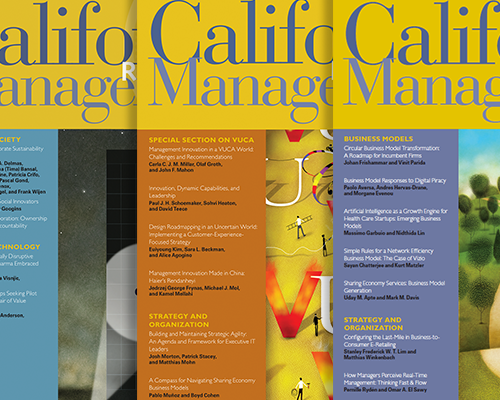
California Management Review
California Management Review is a premier professional management journal for practitioners published at UC Berkeley Haas School of Business.


Our winter special issue features contributions on circular cities, highlighting the importance of urban centers in promoting cross-sector coordination and regenerative innovation in food, energy, construction, and waste
A new kind of practitioner-focused research designed to complement our traditional In-Depth articles
Our winter special issue features contributions on circular cities, highlighting the importance of urban centers in promoting cross-sector coordination and regenerative innovation in food, energy, construction, and waste

 In-Depth
19 Feb 2026
Boyd Cohen, Jan Kietzmann, Mark Esposito, and Andrew Park
In-Depth
19 Feb 2026
Boyd Cohen, Jan Kietzmann, Mark Esposito, and Andrew Park
 In-Depth
04 Dec 2025
Leona Henry and Francesca Ciulli
In-Depth
04 Dec 2025
Leona Henry and Francesca Ciulli
 In-Depth
29 Dec 2025
Shardul S. Phadnis, Suzanne Mooney, and Sarah Grasset
In-Depth
29 Dec 2025
Shardul S. Phadnis, Suzanne Mooney, and Sarah Grasset
 In-Depth
23 Mar 2026
Daina Mazutis, Afolasade Nubi, and Emma Segal
In-Depth
23 Mar 2026
Daina Mazutis, Afolasade Nubi, and Emma Segal
 In-Depth
20 Jan 2026
Nikhilesh Sinha, Satrupa Ghosh, and Shilpi Banerjee
In-Depth
20 Jan 2026
Nikhilesh Sinha, Satrupa Ghosh, and Shilpi Banerjee
 In-Depth
12 Mar 2026
Arash Rezazadeh, Cláudia Antunes Marante, and René Bohnsack
In-Depth
12 Mar 2026
Arash Rezazadeh, Cláudia Antunes Marante, and René Bohnsack

 Spotlight
03 Mar 2026
Annika Steiber and David Teece
Spotlight
03 Mar 2026
Annika Steiber and David Teece
 Spotlight
29 Mar 2026
Barak Libai, Michael Haenlein, Pawel Korzynski, and Grzegorz Mazurek
Spotlight
29 Mar 2026
Barak Libai, Michael Haenlein, Pawel Korzynski, and Grzegorz Mazurek