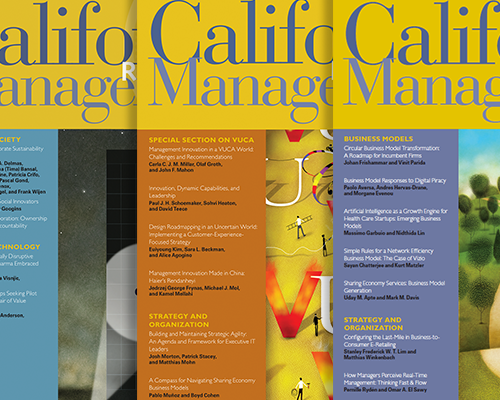
California Management Review
California Management Review is a premier professional management journal for practitioners published at UC Berkeley Haas School of Business.


Our winter special issue features contributions on circular cities, highlighting the importance of urban centers in promoting cross-sector coordination and regenerative innovation in food, energy, construction, and waste
A new kind of practitioner-focused research designed to complement our traditional In-Depth articles

 Insight
21 Apr 2017
Daniel Ginsberg
Insight
21 Apr 2017
Daniel Ginsberg
 Insight
14 Apr 2017
Dennis Takeshita
Insight
14 Apr 2017
Dennis Takeshita
 Insight
10 Apr 2017
Kelsey Chong
Insight
10 Apr 2017
Kelsey Chong
 Insight
08 Mar 2017
Daniel Ginsberg
Insight
08 Mar 2017
Daniel Ginsberg
 Insight
06 Mar 2017
Elle Mahdavi
Insight
06 Mar 2017
Elle Mahdavi
 Insight
17 Feb 2017
Mark Esposito
Insight
17 Feb 2017
Mark Esposito