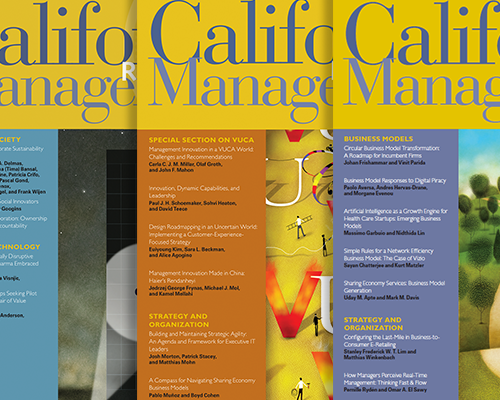
California Management Review
California Management Review is a premier professional management journal for practitioners published at UC Berkeley Haas School of Business.


Our spring special issue features contributions on scenario planning, highlighting new research in real options theory, climate scenarios, senior leadership bias, and strategic decision-making
A new kind of practitioner-focused research designed to complement our traditional In-Depth articles
California Management Review
serves as a source of evidence-based research that inspires, informs, and empowers stewards of modern organizations. We disseminate ideas that engage scholars, educate students, and contribute to the practice of management.
| TYPE | DESCRIPTION |
|---|---|
| In-Depth Article | 6,000–8,000 words (An original, previously unpublished article, blending academic research and theory with practitioner relevance. Should be well-grounded and academically rigorous as well as include practical takeaways for managers. Will be peer-reviewed.) USE THIS TO SUBMIT TO A SPECIAL ISSUE. |
| Spotlight Article | 3,000–4,000 words (An original, previously unpublished article, with a greater focus on practitioner relevance but still grounded in research. Sharp perspectives on modern concepts, organizations, and challenges, but with a more concise format than an In-Depth article. Will be peer-reviewed.) |
| Insight | 500 to 3,000 words (An original, previously unpublished article focused on timeliness, breadth, and practitioner relevance. Can be a perspective, concept, interview, or frontier. Often more theoretical than an "In-Depth" or "Spotlight" article, and is fully Open Access. Online only and NOT a CMR journal publication.) |
| Quick Submit | 500–8,000 words (An original, previously unpublished manuscript, outline, or proposal. Use this if you’re unsure which Manuscript Type to choose or if you’re trying to assess whether your idea/article is a good fit. We will advise you within seven (7) business days.) | Berkeley Haas Case | 1,500-3,000 words (For Haas faculty only. Either proposal or full draft.) |
 Insight
All submissions are processed within our online system. Please log in or create an account here.
View our latest insights.
Please note that we limit authors and co-authors to no more than one insight posted every six months.
Submission is open to current faculty, alumni, executives, MBA and PhD candidates, and motivated members of the general public with an interest in promoting better business practice. Other formats apart from those included above will be considered. Please note that all submissions should seek to provide guidance to practicing managers with a strong attention to current management scholarship.
CMR Insights should aim to provide perspectives on the latest in management thinking and advice for better ways of doing business. Insights examine topics with an eye for both theory and practical application, but in the form of quick glimpses into new topics and emerging frontiers in the field of management.
The focus of the content is on timeliness, breadth, and practitioner relevance. CMR Insights can be either research-based or opinion pieces with reach and visibility. They are ideal for keeping audiences engaged and amplifying existing research in plain language. Insights are quick to be posted and free-to-access by everyone, and may follow any of the following formats:
| Journal | Lorraine Chen Idson et al., “Distinguishing Gains from Nonlosses and Losses from Nongains: A Regulatory Focus Perspective on Hedonic Intensity,” Journal of Experimental Social Psychology 36, no. 3 (2000): 252–74, https://doi.org/10.1006/jesp.1999.1402. |
| Book | Amy J. Binder and Jeffrey L. Kidder, The Channels of Student Activism: How the Left and Right Are Winning (and Losing) in Campus Politics Today (University of Chicago Press, 2022), 117–18. |
| Online Article |
Hamilton Mann, “Escaping Technological Stockholm Syndrome: The Case for Artificial Integrity in AI Design,” California Management Review Insights, September 10, 2025, https://cmr.berkeley.edu/2025/09/escaping-technological-stockholm-syndrome-the-case-for-artificial-integrity-in-ai-design/. |
| Journal | Idson et al., “Distinguishing,” 284. |
| Book | Binder and Kidder, “The Channels,” 150. |
| Online Article | Mann, “Escaping.” |